Rachel Maclean

Rachel Maclean, born 1987 in Edinburgh, is a contemporary artist who uses video to create a bizarre dystopian future that closely mimics issues in our current society. Her career progressed quickly having only graduated in 2009, from painting and drawing at Edinburgh College of Art, she now has shown work for Scotland in the Venice biennale as well as having exhibitions worldwide in a number of galleries such as the Tate and even had a feature film on the BBC.  She uses film and photography to create a fantasy realm that examines themes of politics, society and identity. MacLean transforms herself into different characters with costumes and make up to dive into a variety of different roles. She creates a grotesque, semi-fiction dimension in which the characters represent exaggerated and embellished versions of wealth, fame and consumer culture. Maclean offers a surreal otherly projection of the future whilst hinting towards a frightening, synthetic existence.

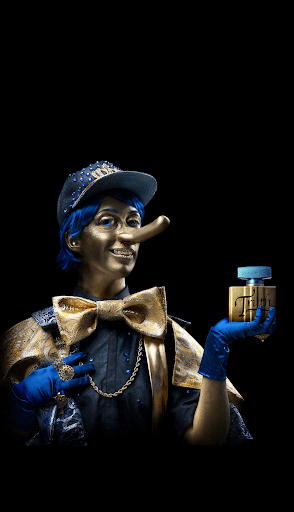
In “spite your face” Maclean creates a world in which the protagonist grows from a disadvantaged social positions into a place of power. He does this by continually delving deeper into a lie resulting in his nose to grow each time, much like the classic tale of Pinocchio, however in this version of the story he is praised for his large nose. The discussion of power is something i wanted to take inspiration from, she uses characters that lack typical morals to create the idea of a seemingly enforced unethical stand point. The idea of persistent, overwhelming pressure is something i want to focus on. A key point about macleans work is that its a show, the theatrical dress up is excessive and potent; full of rich symbolism and motifs. The elaborate materials is something that is relevant to my theme and the prevailing idea that power is perfomance.

Pipilotti Rist

Pipilotti Rist is a visual artist, who works experimentally with installation and video. Her works are a bizarre, surreal exploration of her surroundings known for their vibrant and colourful nature. An essence of play is predominant in her work, by using immersive camera perspective and a vast array of vivid colour, she engages the viewer into her exploratory world.

Born in Switzerland 1962, she studied commercial art, illustration and photography at the university of arts Vienna, then moved on to study at the school of design Basel for video. Whilst attending the school she produced her first well recognised video “im not the girl who misses much”, it shows the artist dancing around in front of a white background repeating the words in the title that were adapted from a john lennon song “happiness is a warm gun. Her movements are energetic and removed from self control, she eventually breaks free from her dress and continues to dance. This work comments on modern life, particularly that for women, moving like a puppet controlled by an overriding commander. Throughout the video the audio and visuals are sped up and slowed down mimicking how time can sometimes drag on or be lost beneath us. I specifically like this video as it has had many different meanings attached to it over time, watching a subject alone with their own thoughts and movements can relate to a wide variety of viewers. This inspired to make work about a solitary experience, the loud noises and overwhelmed flickering image speaks to a person in the moments of self consumption.

Another video that i will take inspiration from is “Ever is over all”, Rist walks lightly with a bounce in her step down the street holding a large colourful flower, she proceeds to smash car windows as she passes in a joyful purposeful manner. The defiance in this video is something i admire, the liberation in anarchic destruction presents a reluctance to conform or play by the rules. The contrast of the carnage and hypnotic softness reminds me of the rage within feminist art that goes alongside the typical image of a submissive woman in the media.

Gillian Wearing

Gillian Wearing is a conceptual artist that works conceptually with photography and film. Born in 1963 in Birmingham, she moved to London in ’83 and attended Chelsea school of art and Goldsmiths college, securing her first solo exhibition in 1993; she is also part of the Young British Artists.
Her work focuses on the connection and differences between public and private as well as the voyeurism and exhibitionism that accompanies it; she has described her work as “editing life”.


One of her earliest works “dancing in Peckham” shows the artist dancing in the busy south London shopping centre, you can see passer by reactions whether they be indifferent or confused. Wearings dancing is clearly instinctive, she is moving exactly how she feels without a care for opinion. However, even though wearings movements are confident and energetic there is still an element of sadness that seeps through , the dynamic between her and the public feels lonely and disconnected.


This made me consider the power within a single person as the focus of video work, i feel like it injects a level of softness as if without the backing of interaction the subject is singled out in their experience. It also emphasises the idea that power is confronting and not diluted down by the inclusion of others; highlighting the isolated nature of a power trip.

In her other works such as “Album series” and “Confess all on video” she utilises masks to enact a certain level of privacy and performance. The album series involves her using realistic masks of her family members to occupy someone else’s identity, it questions how much of someone do we actually see. In the confession series she asks people to confess a secret, whether that be a crime or something that has happened to them. However they are all wearing a mask that completely hides their identity. These masks almost allow people to be more themselves as their actions arent tied to our physical facial identity ,as if they are inhabiting a role of telling a story truthfully without consequence.


This influenced me to layer the audio of innermost thoughts during the experience of a power trip. I feel the use of a mask can distort reality and create privacy in a way that the subject can fully express themselves and reveal what goes on backstage in their reality. The exposure of privacy in wearings work connected to my theme as i feel power trips are a time in which you release thoughts that are usually intended to be suppressed.

Richard Serra

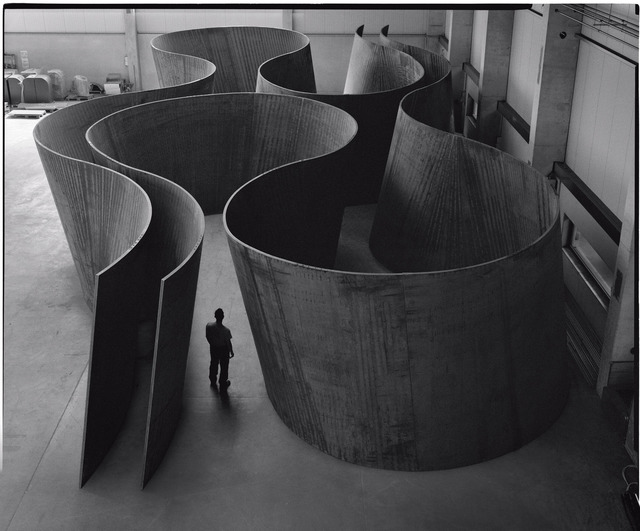
Richard serra, born 2 November 1938 in San Fransisco, is an artist prominent in the process art movement. He shifted the focus of his work onto the steps he took to get the final piece, this involved simplistic drawings and paintings creating a representation of his sculptures. this showed that the journey and thinking towards a resolved piece could hold just as much interest. Serras sculptures have a gigantic, invasive impact to them, they make you feel small and insignificant due to the contrast of the steel curves to the squared off room. The height of the structures tower over the viewer, immersing them in a play of power with the question of their importance. The sheets look as if they are balanced on a thin edge, with the possibility of toppling over, the viewer navigates the space with caution in fear of the magnitude.

There is a sense of motion within them, the turning corners sweep you through and hold you inside; replicating the safety yet lack of control of being in a womb. I was drawn to this peice because of the power dynamic between the work and audience, it has an ability to control and dictate the actions of the viewer. I plan to take inspiration from this into my work by experimenting with the size and weight to incite an investigation into ones own placement within the scale of the piece. I also will use Serras technique of process art by starting with drawings that mimic the feeling that a sculpture could create.

Life Drawing

We began with a 20 min drawing to warm up and then went on to a series of tasks intended to provide us with different skills to create a realistic/in proportion figure. my favourite task was one where we were ordered which part of the body to draw, constantly switching it up. It helped me to draw more intuitively and reminded me to not focus on one bit of the body. Drawing without looking helped me to draw what i am seeing instead of what i think it looks like. I feel more relaxed about life drawing now and know in future that it can take me a while to warm up before actually creating something i like.

Conceptual Evaluation

Beginning with the theme of Memory I thought about things that people wish they didn’t remember such as bad memories or unhelpful advice and through that came to the idea of “Unlearning’. The process of combating pockets of information in your brain is something I was curious about and wondered how someone would do that.

The resolved piece takes a person through that practice and also presents other people’s stories. It challenges your previous behaviour and beliefs and forces you to review how those actions affected yourself and others. Each sheet starts with a belief to unlearn and goes on to acknowledge why it is unproductive and possibly harmful advice- it requires you to apologise and then plan how you will act against the advice in the future. An essential part of the piece is the feeling you get whilst filling out the sheet- it took me back to feeling in trouble in school. I felt ashamed for what I had done and not getting away with it but at the same time it was a demanding challenge to complete as most of the time I didn’t feel my actions warranted a punishment. This seems to present an unwillingness to change, it emphasises the difficulty of unlearning bad habits. I plan to have extra sheets for the viewer to fill out to experience the process as well in order to fully immerse themselves in the feeling of change- and actively reject their negatively ruling thoughts.

I initially wasn’t sure how to present the work as an A4 piece of printer paper didn’t feel like art and could easily be ignored. However, I do feel that it brings the same sense of discipline you would feel in school because of the coloured paper and the structure of the exercise. Lee Lozano’s work played a big part in attempting written prctice as art and also thinking about how it could be presented. Perhaps in a setting with them pinned on the wall and a pile of sheets to take from would emphasise the idea that it’s an interactive art piece. The next step would be to involve others to see how it would be carried out and to further the idea of unlearning past myself.

Working in writing has benefitted how fast I work as it doesn’t take as much physical effort, However, the idea of conceptual work scared me a bit so I was avoidant of creating for the start of the project. Because of this it likely lacks development and I feel lots more work could be done to polish or possibly expand the piece. I also feel that maybe it isn’t that easily accessible because it might need quite a lot of explaining, so next I would aim to discover how an audience would view it and then edit it in a way that anyone could relate.

Conceptual- Memory

i began by looking back at my mind map for the previous project about memory to draw ideas that i hadn’t yet explored and came up with a few routes to be explored:
– Documentation of memories? how reliable can they be? can two people remember something differently but both be true?
– A memory being twisted over time
-Nervous habits- subconscious muscle memory
-Unlearning unhelpful information/habits

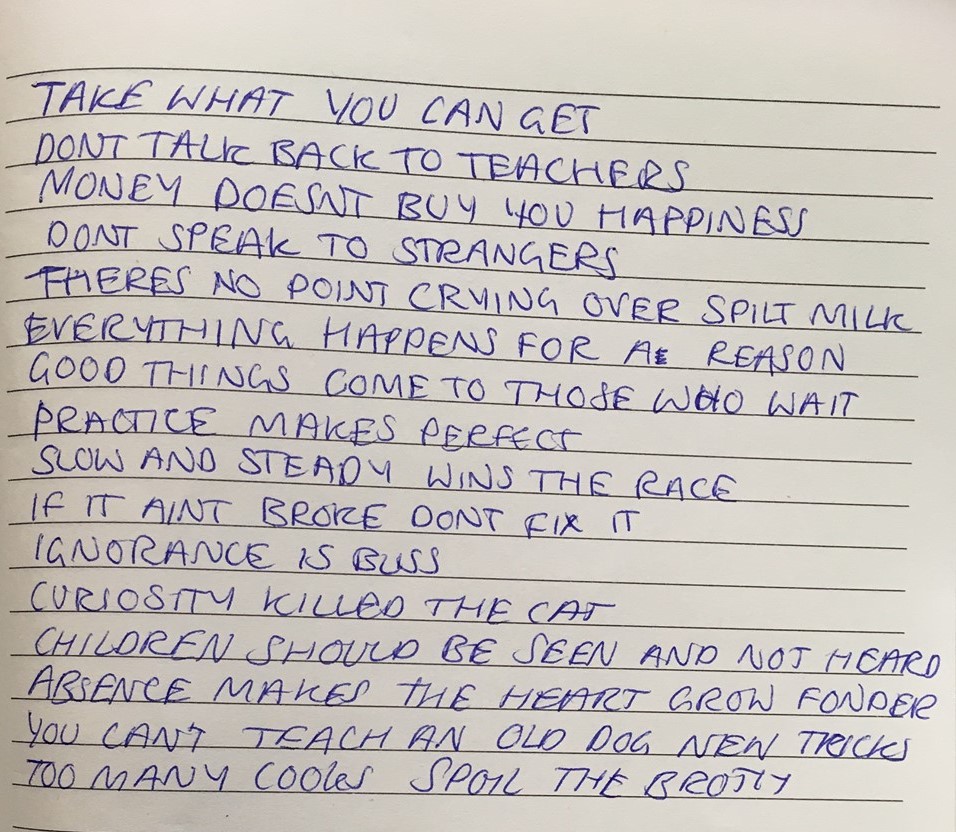
I decided to explore the process of unlearning to see if it’s something that’s possible to do by yourself. Throughout our lives , specifically our childhood, we are fed bits of information and advice that we don’t ask for. It is repeated so much the it becomes ingrained into our memories and often we start to live by it. Often these chunks of wisdom are posed as a positive thing so we buy into it easily, however, on many occasions they are just a means of control. I decided to compile a list of these sayings to explore:

The way they are written reminds me of being in school and trying to learn new information. Perhaps applying the same methods of learning to instead begin a process of unlearning could work the same way. To do this I would need to flip the sayings round to mean the opposite, so to unlearn “ignorance is bliss” I would have to write “ignorance is NOT bliss”. Repetition is a common technique for learning so I brought this in to the process.

This reminds me of the lines you would have to write as a punishment, apologising for your mistake. I tried this with the rest of the statements, however, a lot of the meaning got lost in them and it ended up just sounding cynical. I feel like they won’t be easily that recognisable or make sense unless explained.

The nod back to schools methods of learning also reminded me of “punishment exercises”, a worksheet given to pupils when they misbehaved to redeem themselves and apologise. I want to consider placing these statements in this setting to acknowledge their effect and work on changing how we view them.

This is a rough plan for how it might look- I took inspiration from Lee Lozano’s “general strike piece” with the idea of a simple structured page of writing that lacks visual excitement but however makes up for it with the discussion within the format.

This is the work that i felt was strongest- it challenges your previous behaviour and beliefs and forces you to review how those actions affected yourself and others. Each sheet starts with a belief to unlearn and goes on to acknowledge why it is unproductive and possibly harmful advice- it requires you to apologise and then plan how you will act against the advice in the future. An essential part of the piece is the feeling you get whilst filling out the sheet- it took me back to feeling in trouble in school, i felt ashamed for what i had done and not getting away with it but at the same time it was a big challenge to complete. This seems to present an unwillingness to change, it emphasises the difficulty of unlearning bad habits. I plan to have extra sheets for the viewer to fill out to experience the process as well in order to fully immerse themselves in the feeling of change- and actively reject their negatively ruling thoughts.

Jenny Holzer- conceptual

Jenny Holzers work revolves around the use of words and how they can control and manipulate people in public spaces. she is a conceptual artist born 29th july 1950 in ohio, but based in new york, who has spent time studying in North Carolina, Athens and Rhodes during her 20s. Her first works drew heavy attention and are still some of her most well known pieces, they consisted of sheets of paper showing one line statements known as ‘truisms’. she plastered them anonymously all over walls and windows in Manhattan. They evolved into stickers, T shirts, and even billboards, the collection of slogans amassed to almost three hundred over the span of her career. The Truisms are bold and almost demanding, the way they are uniformly displayed and repeated makes them out to be fact. They were often conflicting and challenging snippets of information yet along side the rhythmic pattern they were presented in they captured the viewer much like the advertisements we see today; in turn this planted the question of what to believe when it came to the information and media we are fed.

Holzers work allowed me to discover that using only words is a valid form of conceptual art and helped me to find the most appropriate way of displaying them. The statements are short and easy to understand because they mimic the way someone would speak, i want my work to flow naturally as if it was being spoken; this could also allow for the opportunity for my work to be developed into audio alongside.

Bruce Nauman

Bruce Nauman is a contemporary artist born in Indiana 6 December 1941, He works with a wide variety of mediums, such as sculpture, photography, video, drawing printmaking and many more. In over 50 years he has undertaken a search for as many different ways of working as he can this results in a broad range of styles and outcomes. His career never adhered to one discipline, he was consistently seeking out any possibility to discover a new realm of art. One of his works explores the value of human perception and acknowledgement, a functioning tape recorder set into a concrete block that supposedly plays a woman’s scream on repeat. it questions whether or not we need to her the scream for it to exist, i also feels it places the viewer in a sense of helplessness with the inability to ever hear what they are told. i like the unease that it provides, it challenges the human urges to see before believing. it requires work form the viewer to have their own input which is something i want to explore more- the idea that a piece partially relies on their perception of it.

Image result for concrete tape recorder bruce nauman