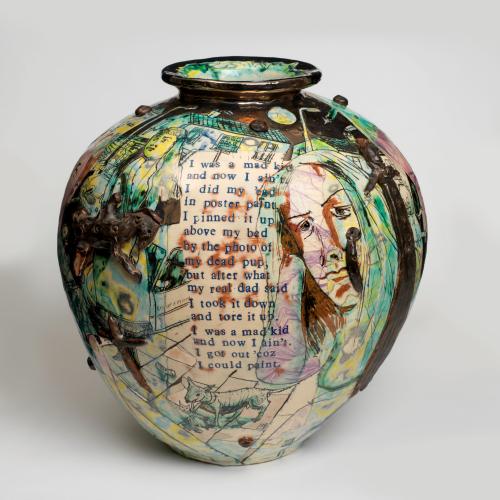
Born in 1960 in chelmsford, England, Grayson Perry is a contemporary artist and writer known for his vases and tapestries. He began the path to his most recognised work by attending an evening pottery class, Within year he was creating his famed vases held at the core of his career. They serve as an absurd story telling tying into a commentary of our time, often depicting scenes of chaos challenging the way in which we understand the world around us. These tales knit together with his own autobiographical references, some telling a narrative of nostalgia and lost innocence. I like the idea of bringing a familiar household object and adding value to it with a story, it feels easily accessible by the viewer because of its domestic connotations – it doesn’t require any special knowledge to understand. This makes the art approachable and somewhat interactive with a nod towards function, we don’t feel so separated from them like you would with a painting on a wall.
I began by racking my brain for memories of childhood, experiences, events but failed to find any that stood out. A large section of my past has been blocked out or brushed over, perhaps a way of coping with a difficult childhood but also perhaps because positive memories haven’t held as much of a dominance and control over me. Instead of recreating or reassessing my history, i want to look into how much of it is not with me anymore. the thought of a “mind like a sieve” resonates with me, often i find myself focusing on something then letting the rest fall through. Inspired by Edmund de Waals work and the B.F.Gs dream jars i started to think about memories as receptacles like little cups of things in our past some overflowing, some full, some half empty.
I pieced together small flakes of clay without giving much thought to the function of the bowl, keeping it delicate.
I filled the clay bowl with water to see how it would function. all of the water seeped out and eventually the bowl collapsed as the clay was unfired. i liked this unexpected feature and felt i could play on it some more. this one bowl feels to singular to represent a collection of memories so i aimed to play around with more shapes and layouts.
i started to work more instinctively, following where the clay led me with the plan to make some kind of receptacle. the outcome was very organic shapes that could fit together-this contributed towards the idea of a collection of these cups, like a net of memory some relying on each other for support and some unable to stand up.
These cups felt very precious and reminded me of bowls i had in the house when i was younger, we weren’t allowed to use them daily but where brought out for special occasions- cherished, cared for and attached to a long history passed through my family.
I painted them white to replicate the porcelain bowls, however, i feel this takes away from the fragility of them and hide the texture of the clay. i also don’t feel i had the right technique and time to paint them exactly like precious bowls effectively so decided to leave this idea aside.
Playing around with how to lay out these bowls helped me to picture what could be a resolved piece so that i could tweak them appropriately. i love how these all fit together naturally however, i liked the involvement of water in the first piece and these would fail to hold water in without spilling out immediately.
I accidentally dropped one and noticed that one of my hairs were holding it together- i started to think of how fragile memories can be and how delicately something can be held together. i came across a Japanese tradition of ‘Kintsugi’- when a bowl is broken they fix the cracks with gold or other precious materials to honour the history of what the bowl has seen and gone through. this could add another layer, a visible, physical memory and also the suggestion of how memories aren’t always fully intact. The pva glue looked too rough and lacking in meaning or worth, so decided to add bold childlike colours to the. join.
I love the idea and look of these, I feel the colour brings and aspect of joy to the bowls. Although I feel it is somewhat distracting and also would need some not to be broken as I want the idea of a solid cup of memory to pull through. I also wanted them to hold water in for varying lengths of time until the pva weakens and they fall apart, however, in this video you can see that they just disintegrate all together.
the next step was to experiment with the cups I had, I tried to add water slowly and unevenly in hopes that they would melt at different rates.
As the cups couldn’t stand on their own I hot glued them together, this looked ugly and took away from the simplicity . I planned to make them able to support themselves.
I was really pleased with this work, the staggering of disintegration, the simplicity and the fact that they stand on a very precarious point feels like strong imagery. It however will require my interaction with it at the start and once the reaction has happened it will be left as a pile of clay and water. I question whether it needs a time lapse to accompany it or whether it can stand alone.
During the Crit we discussed whether I needed to have a video alongside in order to show the process or whether that makes it too obvious and explanatory. I now feel that it’s unnecessary and distracting and that the left over clay speaks of a distant and incomprehensible memory. the crits also brought importance to the use of clay and water, they are both a hint to my own past ; making mud pies and interacting with water. Both materials were a source of escape for me, both bringing a childlike joy and instinctive play. We also discussed the type of interaction with the piece- shall I pour the water at the beginning and let people watch as they collapse? or shall it be guided by the audience, encouraging them to pour the water? Ultimately I feel the audiences connection would benefit, the idea of attaching a network of others mimics the net of memories built up in each individual. I also realised that this could breach the realms of performance and could be used for the ‘Body as material’ exhibition as the human involvement is essential for the works true process.
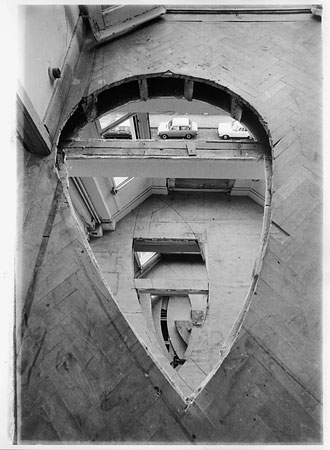
He began his career by attending Cornell university to study architecture not breaching into the art world until much later. Combining his creativity and breadth of knowledge of architecture he developed structures know as ‘anachitecture’- these works broke up the framework of typical buildings by slicing into them. Large sections of building were sliced out, often in teardrop shapes, abstracting the structure and cutting new depths into the building. initially you would identify a rejection of architecture ,however, his learning of the subject was actually considered to be the material and fuel he worked with; bringing attention to sections and layers of a building and creating an appreciation for the often unnoticed support around you. The choice of a domestic setting intrigues me, along with the pictures, it highlights a sense of past; like scanning through old memories piecing together broken up events and surroundings. The fact that these buildings are cut up makes the original purpose of them redundant, i want to take inspiration from this by breaking up my pieces so that the function of them no longer exists, bringing connotations of an active past and a current deterioration.
Bourgeois work is fuelled heavily by her past and childhood, from a first glance you can witness raw emotion, experience and the significant role her history plays. Her mothers illness and fathers affair were events that plagued her throughout her life and art. She states she is “a prisoner of my memories” – her creativity stems from the desire to rid herself of the terrible experiences she had endured- holding on to them and letting them guide her through her future with all the intensity they bring. Her ‘Cells’ specifically delve into her past, like capsules of memory they are inclosed, held in a precious space, cherished and resented. They keep alive the power of her memories by altering her recollection to emphasise her perception. The idea of an enclosed space inspires my practice, it reminds me of the undeniable dominance a negative memory can hold. The imbalance is something i plan to explore and hopefully discuss the inequality of space these memories grip.
Edmund de waal is a modern ceramic artist, known for his vast installations of simplistic porcelain pots. He says that the repetition of making and producing is and expression of time, his works are all lined up and unified however still show unique stories and a snapshot of time in each individual pot. ‘A thousand hours” explores the significance of the process leading up to the exhibition of work, the name forces you to consider the process as something equal and as full as the outcome. The shelfs replicate something you would see at home, collected goods protected and out of reach, familiar but special. This formed connections with my project of short term fragile memory due to process you go through whilst looking at them. He explains that the idea is that you catch sight of something then focus on that and then soon loose that pot amongst the many others; still there but currently irrelevant, pushed to the back of your brain. You can see the history and memories preserved in a physical object, the fingerprints and imperfections bring back a reminder of the hours spent touching and shaping the clay.
For the induction day we were given 5 slabs of plywood, i tend not to enjoy working in flat pieces to my first thought was to stick them together and carve into it. However, the layers in the wood broke away easily so was to complicated to carve into. My aim was to create organic shapes, contrasting the material given, this was proven a lot more difficult than expected. I decided to just use two sheets that slot into to each other to breach the 3D space. If I were to use wood again I would use a different types and seek out some carving tools to create a more solid mass.
Day 1
The process of making then drawing repeatedly, forced me to remove myself from any perfected idea of a sculpture. i became aware of thinking in a 3d space by making mistakes and then learning from them in the next paper sculpture. The time limit ensured quick meaningless decision making, there wasn’t time to go back and alter anything, i had to just move forward. This taught the idea that even if i am stuck i can still carry on making and thinking creatively, there isn’t a need for something to look right straight away, sometimes its important to just get started in training your brain to think in 3d.
The last task of the day was to make a resolved piece with the luxury of any material available. I instantly went for the cardboard as it is sturdy, and i felt it could bend and up hold my developing shapes. I was not pleased at all with the outcome, i felt i had lost steam and the material wasn’t working how i wanted it to. There are some interesting lines and some of the repeated negative spaces are strong so could draw some inspiration going forward. At the end of the day its just cardboard and wasn’t too disappointed keeping in mind that this is just a technique to keep me going.
Day 2
Sculpting with only fists
Sculpting with only fists
Sculpting with only fists
Sculpting with only fists
Using wooden sticks only
Using wooden sticks only
Using wooden sticks only
Carving with wire
Carving with wire
10 min drawing
10 min using clay + charcoal
10 min using clay
The tasked was aimed to limit the tools we could use, creating a separation between us and the material, and removing ourselves from the full control. There was something about using my fists in the clay made me feel like a kid playing with playdoh, i didn’t care for the clay and instead just had a need to figure out what shapes and lines i could make with my hands. Again we alternated between drawing and making, this helped me take a step back and critically analyse what looked good and where shapes looked flat. Using the clay to draw also hindered the ease of it, it proved more challenging, however, when i stopped fighting with it i relaxed and used what it could give me to the best of my advantage.
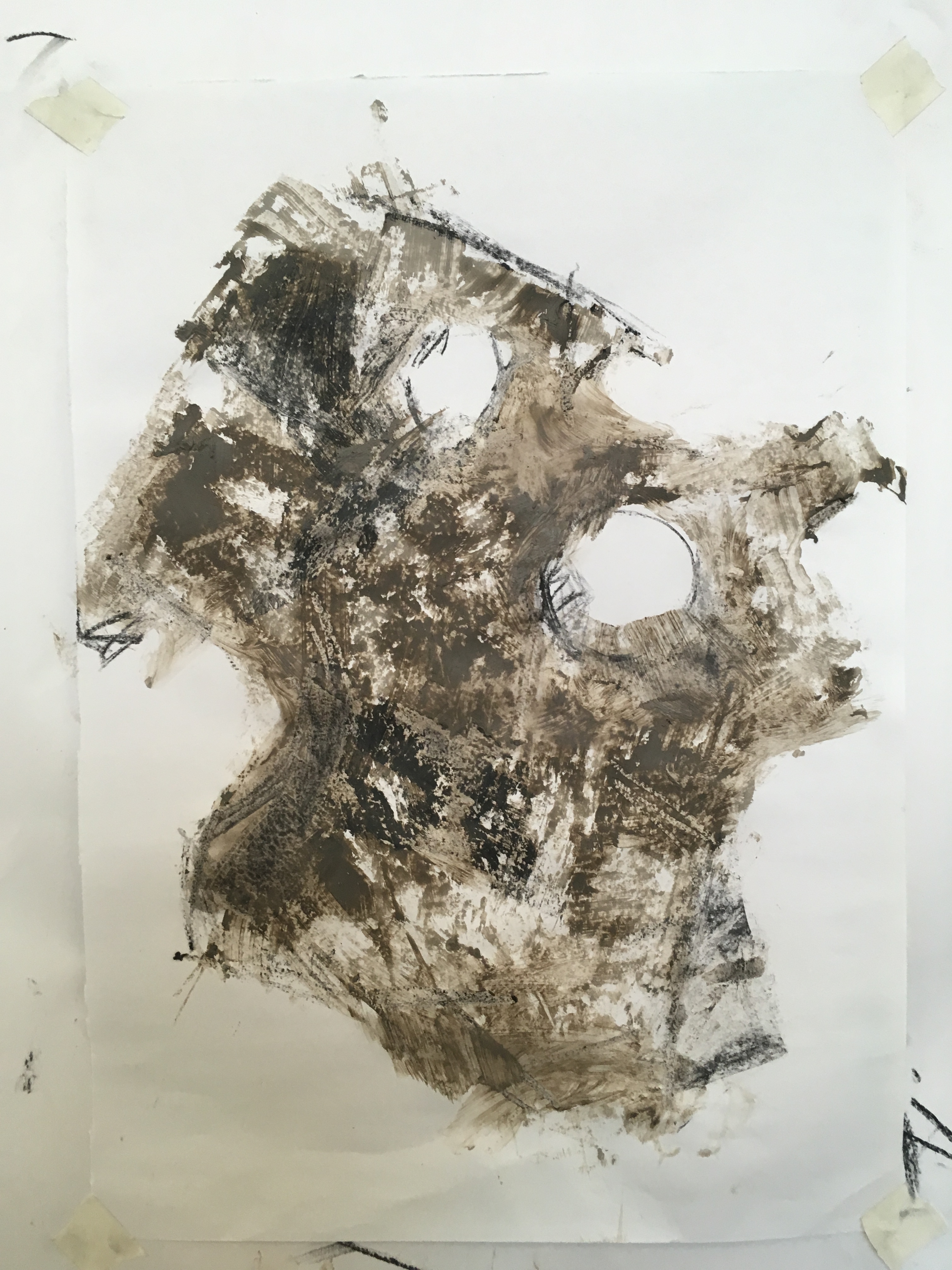
Through these practices i found that i enjoyed taking away from the clay more instead of building it up. i like the curves and organic shapes it can provide, cutting holes in it reminded me of small animal tunnels. i like the idea of not being able to see every edge of the clay, you are forced to look from all angles to find out where the tunnel leads. i can picture a variety of these in different sizes scattered at ground level, it reminds me of boulders you would find on the beach.
Day 3
Im not very fond of casting, it feels a bit lifeless and controlled. i tried to recreate the holes/tunnels from the last work and incorporate them into a swirling landscape. i was quite disappointed by the outcome, i liked the holes as it looks kind of gross and it brings an interesting texture, however, i feels very confined and doesn’t consider the 3d space. this is perhaps a technique i could develop and hopefully find my way around.
Day 4
We had the chance to spend a day making a resolved piece, i decided to carry on the idea of making a series. i like the process of making these as i can just follow where the clay naturally goes, i found it very therapeutic as i wasn’t battling the clay to look like something its not; this taught me that if i get stuck i can let the material take over and trust in it. i like how some of the holes can match up, when you look down through one you can see through the next tunnel. In the large one the holes are all interconnected, i can appreciate the idea of a hidden landscape inside and plan to play on this.
Day 5
The task was to create an installation in a small group using whatever we could find, taking inspiration from the pace we were in. We felt the space was very controlled, sturdy and harsh, so we aimed to break that up by contrasting it. Focusing on keeping things light and balanced, we propped up planks of wood and dowels carefully to mimic the shape of scrim hung from the light. I was pleased with how the lines of the dowels drag you through breaking away from the 90° walls and how precarious it feels as if you touched it it could fall.
This task was the same, however, we were not allowed to communicate with each other. this was a lot more of a challenge because i am very opinionated and often take over with my ideas, but because we all just had to do what we thought it forced me to take a step back and watch what others were doing. The boards required team work to balance them up against each other which felt impossible without talking, we had to really tune in to each others actions. i realised after that even though we couldn’t speak, we were still communicating through what we brought out visually , i began to observe and acknowledge others ideas instead of pushing my own.
This task involved us adding to it one by one, reacting to what has already been placed down. It was interesting to watch what people were placing down and try to guess what their aim was, and then trying to tie in what you had envisioned. We all felt that they looked like a tableau, as if someone had got up and left. it feels like a mystery trying to figure out what had happened, telling a story of someone.
The final task was to create in installation that we could display our work on. we felt all of the objects we had to work with would be to distracting from our clay work, so we decided to use the whole space so the installation was immersive and would become part of the rooms landscape. the draped sheet helps to tie everything together dampening the importance of the objects and finding an appreciation for the space they create. i feel this piece makes good use of the space whilst providing platforms for work to be shown on.






 Abigail yeats CAP