Born in Matsumoto, Japan 1929, kusama is known for her obsessive repetitive paintings. she engaged in very little formal training only studying for a year in 1948 at the Kyoto city specialist school of arts; very few pieces of work from this time still exist as she destroyed much of the early stuff. she brought her work to new York with a desire to become and artist in 1957.
her work began out of a use of patterns and mark making as a therapy for her, endless repetition mimicking that of her hallucinations; this however predicted the minimalist movement and pop art. The work mimics the patterns and shapes you will find in nature, realising how similar we all are in our biological make up.
The kaleidoscopic organisms repeated gives us a feeling of insignificance, they are endless unlike us. Human brains work by recognising patterns and making an observation to inform our actions ; I feel this could feed into my theme and perhaps create fear with the repetition of inexplicable movements. her paintings replicate the process our minds go through when presented with fear, at first it seems bold and uncompromising yet with repetition the impression of danger is overcome or realised as unthreatening.
Born in west Germany in 1973, and moved east to study painting at Leipzig’s Academy of visual arts in 1995, receiving his Masters in 2003. he began to study under David Hockney. he co food the LIGA gallery led by artists in Berlin.
his paintings morph reality and imagination, abstract and figurative, he explores deserted three dimensional spaces. he constructs these spaces with paint to build up a room often disregarding the rules of typical perspective. This perspective is inspired by Hockney, altering what is expected by the viewer, placing focal points slightly off. It involves the viewer into the painting, feeling party of the open inviting space.
I was particularly intrigued by this piece ‘Corner’ 2005, it feels eerie mysterious. the dark colours in the centre draw you in , it feels like you are about to turn a corner anticipating what’s about to come. Thick paint creates intense depth with coulees like dried blood peeling off the edges.
Many of his paintings provide an atmosphere apprehension like there is something we don’t know, perhaps more to the story. A dark corner, shadows under the dest, ambient lighting it feels like a stage before performance; something is yet to come.
An American printer, painter and collagist born in 1965, working in Rotterdam and New York. Her work fixes on the sense of otherness being born in America but of Scottish and African decent. Having a biracial identity fuels much of her work by exploring stereotypes predominantly for African American. A portion of her student years were spent on a marine research vessel, studying and drawing on the mysteries of the sea supporting her fascination of microscope life and oceanography. I was drawn to her work because of the themes she explores as my project is partly focused on the desire to know the depths of un answered questions- the sea is a source of inspiration with al th odd creature that are essential to our ecosystem and the exploration of newfound areas. Her themes knit together with her ongoing project titled ‘Watery ecstatic’ combining her knowledge in the marine world and exploration of the myth of Drexciya; an underwater world built up of the unborn babies of pregnant African women that were thrown off slave ships who adapted to breath underwater and survive.
From a distance you can see delicate swirling water colours, an abstract underwater botanical scene yet up close you are hit with something darker and harder when you discover the small stereotyped black faces ,mimicking minstrel images, stuck to the paper.
Gallagher also explored minimalism through her collages, heavily inspired by Agnes Martin. Involving grid formations and minimalist geometry, it emphasises a sense of power and order binding together her many themes by repeating patterns throughout. ‘Paper cup’ is a large scale canvas layered with sheets of paper lined and imperfectly arranged in rows leaving the paper to wrinkle. Upon closer inspection, the same racist Minstrel faces appear .
I began by exploring how easily people can be convinced so easily by something that may turn out to be illogical or false. It lead me to the need we have for an answer, how we don’t feel comfortable leaving something as a mystery. I looked into the psychology behind beliefs and came up with a mind map of research to feed into a feeling I want to portray.
Summed up, this mind map realises that it is our natural instinct as a way of protecting ourselves to search for patterns, learn by imitation and infer intentions. Our subconscious tells us to constantly make observations and fixate on the negative or dangerous as they pose the threat that we could avoid or fix. The unknown is the most natural fear, so we turn towards it and dig to reduce the threat. I plan to reproduce that feeling through the work I make so came up with a (still growing) mind map to discover how to do so.
The word ‘Writhing’ particularly popped out, it motivated to think more visually about the movements of 2d work. I produced two drawings of what I feel that would look like.
These drawings reminded me of blood vessels/nerves/bodily tissues, something verging on grotesque. I plan to use these style of drawings further into the project. As well as I feel they represent the word writhing well, I don’t feel like I have any supporting imagery to branch off from; these images were more like doodles form my head rather than something of substance. I began to look fro imagery to work from.
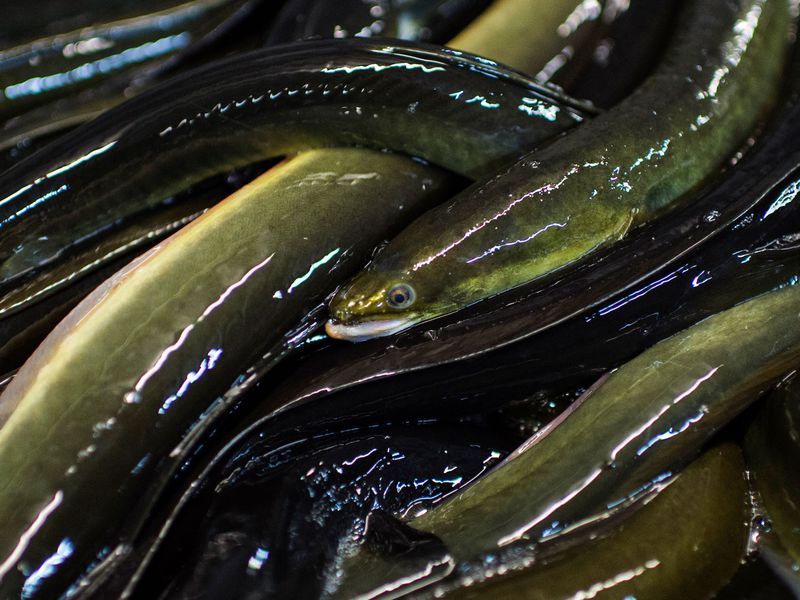
Eels are one of my fears yet I find them oddly endearing and beautiful, so I thought it would help fuel the concept. I think the way they squirm over each other is mesmerising, it reminds me of how people can get tangled up in knots trying to make sense of something inexplicable. I began with drawings of the subject.
We received a workshop on stretching paper, priming and using wet materials eg. bleach, ink, paint. I used the eel imagery to carry further as a starting point.
I noticed that a lot of my work just feels like a background or pattern and not much thought has gone into composition, I’m struggling to find objects for focus. Playing with the wet materials helped me gain a feel for them however, I don’t particularly like any of the pieces, they seem incoherent and irrelevant to my theme. it was perhaps limited due the time it took to stretch the paper which made me precious about it. I started painting on cardboard instead.
i like the textures created by ink and bleach to replicate the patterns of eels. I was particularly by the last one, i used wet emulsion and scratched into it with different tools, it reminds me of looking through a microscope to subtly squirming organisms. Starting to like my work, I felt motivated to relax and produce a larger piece.
I like the subtlety of the oil bar being dragged to the right and strengthened by the red pencil. however the outline could be bolder. I feel it really represents the word writhing but it is a bit too gentle to look at, there is no question of what it is or reluctancy to look at it. the composition is a little confused, I can’t see any strong focal point. there is lots to work off but it has successfully fuelled me further.
Two pieces of stretched paper failed so i decided to use them for excess paint and material i had, to see what comes of it.
The composition of both are a mess however they could be useful as prepared textured surfaces or as a practice for techniques. i like the cracking on the left one, its seems to be in the process of revealing something, presenting a mystery.
We then learnt a new technique, using the printers various settings to alter the colours or print onto alternative surfaces. i ad a couple attempts at this but am yet to use it to full potential.
i attempted to combine techniques iv’e learnt throughout this week onto one piece. i carried on the idea of scratching/peeling away paint to reveal i picture printed on acetate.
the composition needs a bit of work, but i like the idea of the peeled away areas, as well as the texture of the oil bar.




 Abigail yeats CAP