Jenny Holzer- conceptual

Jenny Holzers work revolves around the use of words and how they can control and manipulate people in public spaces. she is a conceptual artist born 29th july 1950 in ohio, but based in new york, who has spent time studying in North Carolina, Athens and Rhodes during her 20s. Her first works drew heavy attention and are still some of her most well known pieces, they consisted of sheets of paper showing one line statements known as ‘truisms’. she plastered them anonymously all over walls and windows in Manhattan. They evolved into stickers, T shirts, and even billboards, the collection of slogans amassed to almost three hundred over the span of her career. The Truisms are bold and almost demanding, the way they are uniformly displayed and repeated makes them out to be fact. They were often conflicting and challenging snippets of information yet along side the rhythmic pattern they were presented in they captured the viewer much like the advertisements we see today; in turn this planted the question of what to believe when it came to the information and media we are fed.

Holzers work allowed me to discover that using only words is a valid form of conceptual art and helped me to find the most appropriate way of displaying them. The statements are short and easy to understand because they mimic the way someone would speak, i want my work to flow naturally as if it was being spoken; this could also allow for the opportunity for my work to be developed into audio alongside.

Bruce Nauman

Bruce Nauman is a contemporary artist born in Indiana 6 December 1941, He works with a wide variety of mediums, such as sculpture, photography, video, drawing printmaking and many more. In over 50 years he has undertaken a search for as many different ways of working as he can this results in a broad range of styles and outcomes. His career never adhered to one discipline, he was consistently seeking out any possibility to discover a new realm of art. One of his works explores the value of human perception and acknowledgement, a functioning tape recorder set into a concrete block that supposedly plays a woman’s scream on repeat. it questions whether or not we need to her the scream for it to exist, i also feels it places the viewer in a sense of helplessness with the inability to ever hear what they are told. i like the unease that it provides, it challenges the human urges to see before believing. it requires work form the viewer to have their own input which is something i want to explore more- the idea that a piece partially relies on their perception of it.

Image result for concrete tape recorder bruce nauman

Lee Lozano

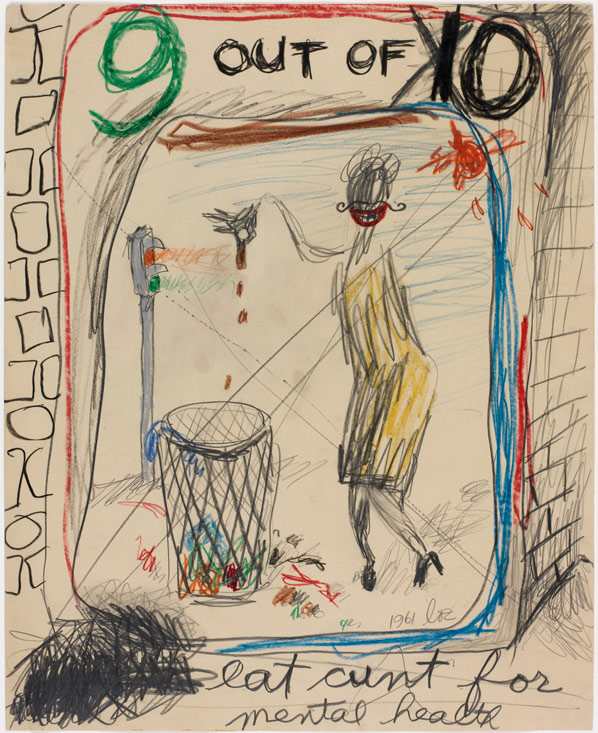
Born 5 November 1930 in New Jersey, Lee Lozano was a painter and conceptual artist known widely for her graphic, abstract drawings of genitalia-like shapes. she was at the height of her career during the 60s with striking, large scale paintings of tools, they felt human like as if they were in motion- the curves and brush strokes feel seductive due to their exaggeration. Alongside these were her ‘comix’, rough sketchy drawings of people, teeth and mysterious holes often accompanied with provocative statements like “eat cunt for mental health”. she was bold, there is no subtlety to her work, the shapes are phallic and suggestive- it impossible for the viewer to escape the erotic connotations.

Image result for lee lozano comix

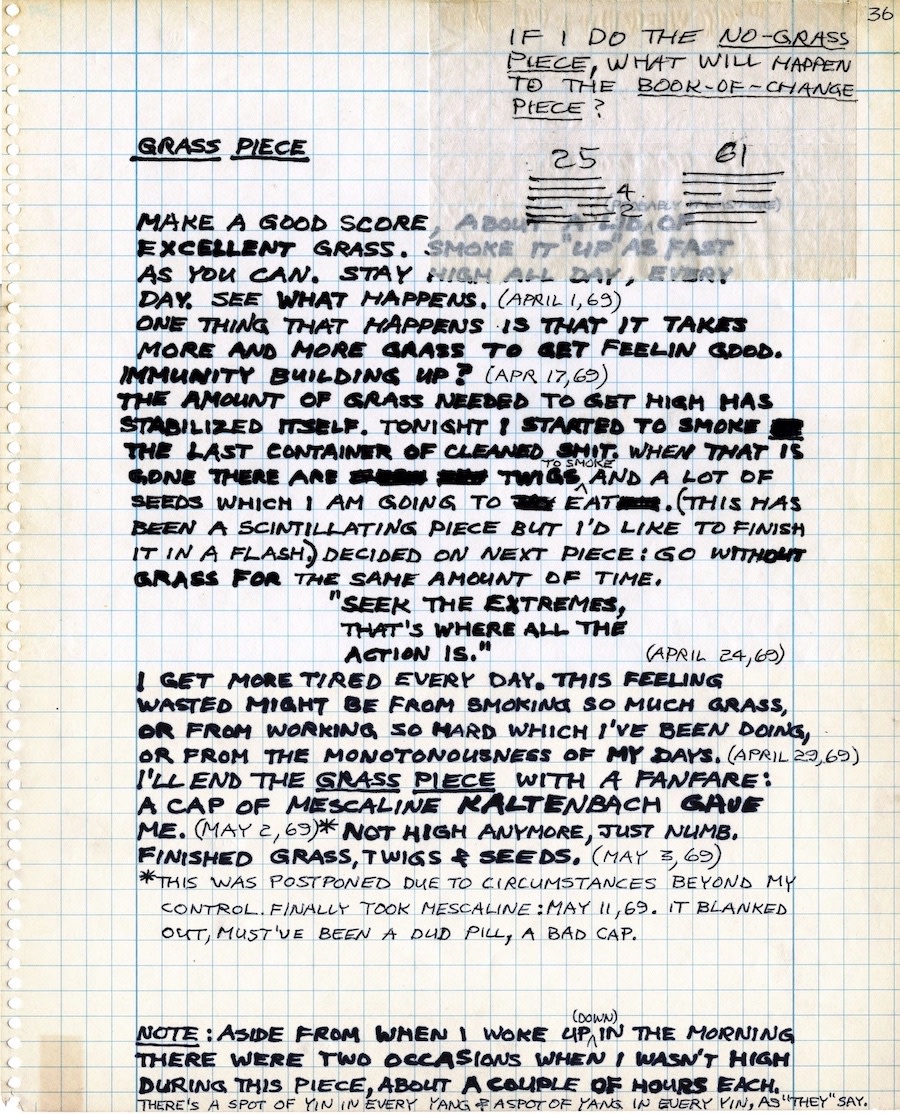
Following this work came ‘General Strike Piece’ in 1969 in which she gradually began to reject the art world by creating instructions for herself that guided her withdrawal. She set out tasks such as, avoiding being present at any public functions and would then document how it went. This wasn’t just a rejection of the art world but also a bold play on how she lived her life- the experiments also included smoking weed everyday for a month in ‘grass piece’ and moved as far as boycotting women which lasted until her death in 1999. Despite the goal of renouncing the art world, this in turn became her most highly praised piece. i like how the visual aspect of this piece doesn’t instantly portray expression however when reading you get a very personal insight into her mindset and opinions- this contrast is something that i would like to explore.

Related image

Lawrence Weiner

Born in 1942 in the Bronx, he now spends time working and living between Amsterdam and his home New York. Weiner was a prominent figure within the conceptual art scene of the 60s, questioning an alternative relationship with art. He uses language and typography to create installations that play with its environment and setting, and aims to have the ability to engage anyone who passes it.

He highlights that art is for people by people, the connection between multiple minds is the reason for art to exist. He discusses that the whole point is the objectification of something to be communicated.
I am particularly interested by the idea of creating art within another persons mind- the objectification of thoughts that could translate to someone else and evolve within them.

In 1969, he created “statements”, a book consisting of only words which weiner felt had the same desired effect as creating the object. he investigates whether the art needs to be actually physically exists to be regarded as art whilst also examining ownership of of art, is knowing the art the same as owning the art as you cannot unknow it?
His art has completely flipped around what my idea of what art could be, although i knew words could be used as art, i thought that it required a visual/ physical element to appeal to people as art. i am still discovering what conceptual art means and feel that i would benefit from taking more of a risk by creating something that could be art but could also be disregarded as nothing.