


Hayley Tompkins, born 1971, is a visual artist working in glasgow. She creates installation and produces work that can move between object and painting. i was drawn to tompkins work for the colours and the atmosphere of her paintings. Often i look for a concept or try to understand the reason for creating, however ,i’m trying to enjoy and experience work more for just the visual qualities.
“I don’t want people to feel alienated by the objects i actually want people to ,ideally, look and think i know that already” – she talks about the viewers interaction with the art and i feel that this is an important point for my theme. i want people to see comfort and caring within my work and i think that comes from recognising familiarity.
Her work ‘digital light pools’ (2014) for the venice biennale was displayed over two rooms on the floor, with a collection of photography amongst paintings, it feels as though you are sifting through visual memories. i love her muted colours that feel so nurturing, you aren’t forced to look for anything specific. The minimalism of the work helps to break down our observations and simplify it though colour. she very carefully thinks of how the work is presented, in the bottom left picture, the canvases are spread at uneven intervals; i like how this softens its presence without feeling too assertive. Her work has inspired me to take a step back from the concept and explore the visuals of my work more.
SP1CONTEXTUALRESEARCH
Douglas Gordon


Douglas gordon, born 1966, is a scottish artist that lives and works in berlin. Known for his video work he explores the subjects of collective memory and repetition often using his audience as an important part of the work. He uses old found footage along with text and performance to challenge and question his audience. Gordon avoids imposing meaning onto his work , as his aim is to motivate people to take time to think; his work opens up a world for self- exploration.
-His work often uses words to address the viewer like ‘i’ and ‘you’ creating a direct connection with the artist. It can be confrontational or relatable, with words so directly connected with communication its hard to ignore what they might be trying to say. On the contrary, his words convey ambiguity the viewer can place any meaning they like within these works.
-I like how words can be taken out of context and altered to the readers state. i feel that no matter how clear you are with what you are trying to say it will never be read exactly as intended. this made me think about how automatic writing can be used; often the bits of writing can be incoherent, something that makes sense to you could be nonsense to someone else.
– you can see in the way gordons words are often presented are so structured and thought through, the placement of his words are heavily considered so that it holds importance.
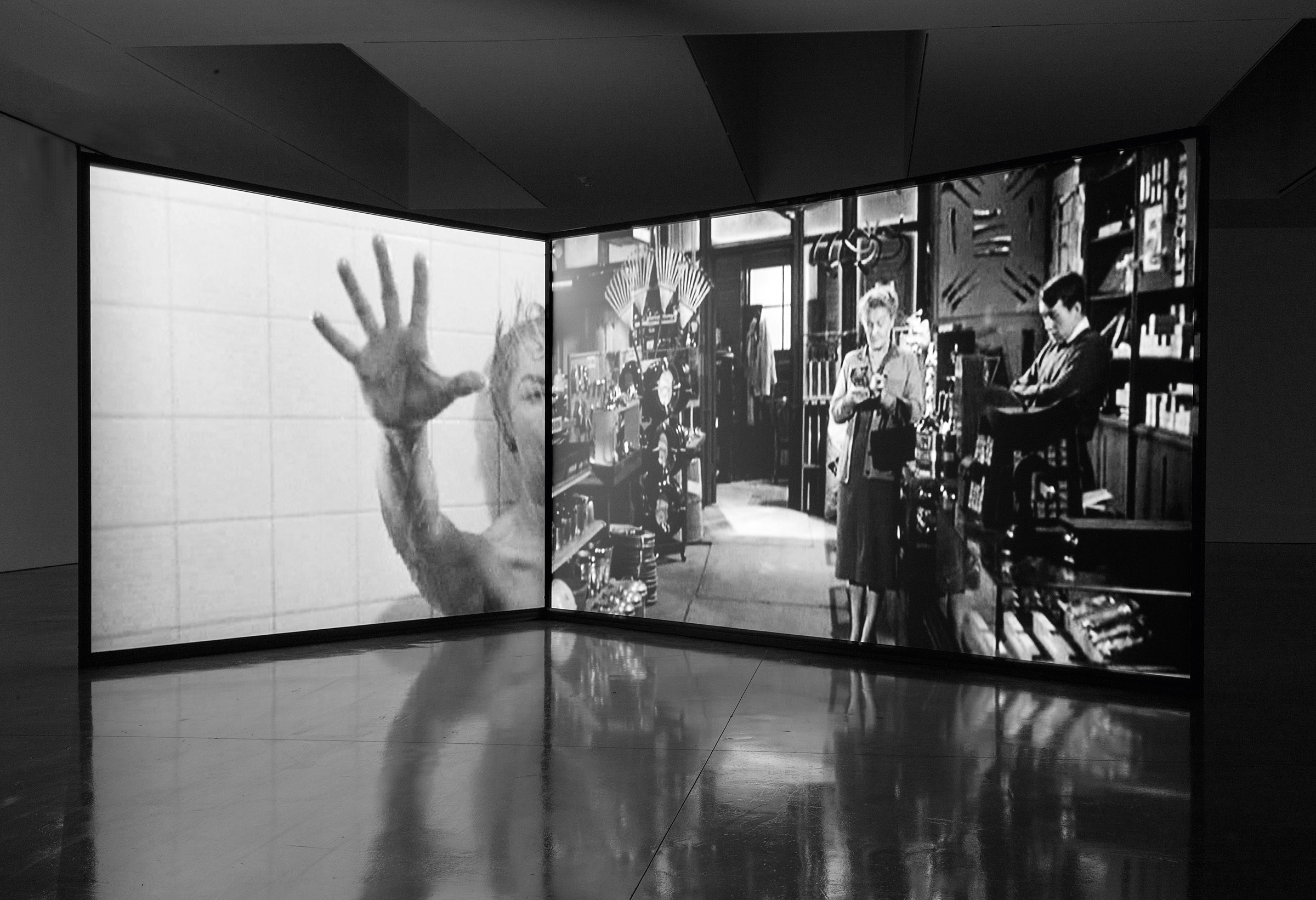
– In other works such as “24 hr psycho” he manipulates well recognised footage to alter its intentions- he slowed down the film “psycho” by Alfred Hitchcock to span over 24 hrs. The storyline is lost, it creates a break in time; you begin to investigate other elements of the original video and consider our own response.
– Often when taking time to daydream/meditate/slowdown words make their way into my mind that dont always connect. Having looked at douglas gordon’s work i want to play with this in spoken word and video to show passing time and movement; experimenting with the permanence of words.
Guido van der Werve

For 24 hours Dutch artist Guido van der Werve stood on the north pole, turning at the pace of the earth in the opposite direction of the earths rotation. “Nummer Negen: The Day I Didnt Turn With The World” (2007) plays with the chronological understanding of time by physically turning away from it- the movement of sun and shadow show a visible cycle of time whilst the central figure shows a constant unchanged form. Condensed into a video of 8 minutes is an observation of an ultimate standstill moment- the focal point being a point of calm immersed in passing winds and ice cold temperatures. This work shows a simple stillness contrasting with the endurance of the artist and internal stamina, you can only images the thoughts running through his head over this lengthy period of time.
Van der were extends the ideas of his work into his own life, splitting his time between a quiet lakeside in Finland for half the year and busy, social Berlin for the other half. He talks of Finland being a place to refuel without the pressures of deadlines and time saying that “lots of good ideas are born from boredom”. This relates to the idea of slowing down being a powerful tool in creating something great .
I like how this work enters a meditative realm with a moment separated from time and environment- I hope that this work inspires time based explorations and helps to investigate a ruminative state within video. The vast and bare landscape along with muted colours provides a representation of calm that I can use to influence my work.
Anja Jelovšek


Anja Jelovšek is a conceptual artist born and based in Slovenia, she graduated the academy of Fine Arts and Design in Ljubljana in 2014. She creates work in sculpture drawing and installation .
In these two works pictured she explores the topic of time and work in its most basic understanding, whilst also discussing a human relationship to these concepts. In “eight hours of work “(2018) she creates a series of eight drawings each representing an hour of work; using pencil to draw systematically, resulting in a paper completely covered by continuous orderly lines. at first glance they don’t look too dissimilar however after close inspection you discover how varied the lines and paper coverage. No matter how meticulous the artist was with these disciplined and Time controlled drawings none of them were the same; i like how this reflects the human relationship with work by showing and incompatibility with a methodical standardised process. Similarly in “Jolly Neonorange” (2018) the ork shows using up time in a way that becomes tangible, with one coloured pencil the artist uses it to completion.
i like the way the artist presents the passing of time within slow manual work. The viewer can see the areas that the artist gives up or slows down. The contrast between the regulated materials and the variation in the work recalls the experience of an individual enduring increasingly intensifying work.
This has influenced me to explore repetitive work and how that effects a person. I can imagine works similar to this but perhaps exploring something never ending; a pointless task that is only there to consume time. It could maybe be used as a way of slowing down by doing physical work or maybe used used to represent a defiance of productivity.
 Abigail yeats CAP